Posts

Showing posts with the label ubiquitous computing

My STEM Journey

Image
I recently had an opportunity to share my STEM Journey with students who attended the Stemettes Monster Confidence event at CDW in Peterborough.  The slides below are from my talk, which highlights how my interest in computing and electronics, and a sustained curiosity that has led me to a career in academia. My STEM Journey - Arosha K. Bandara   from  Arosha Bandara

IET Innovation Awards Finalist! Winner!

Image
Update (16 Nov 2017):  I am very pleased to announce that the Privacy Band was chosen as the winner of the Cyber Security category of the IET Innovation Awards.  Vikram Mehta and I were presented the award which is a fantasic recognition of our invention. "Privacy Band", our novel privacy management interface device, was a finalist in the Cyber Security category of the IET Innovation Awards .  The above video shows me discussing and demonstrating the device, which embodies a metaphor of "Privacy Itch" and "Privacy Scratch" as a mechanism for privacy awareness and control. The IET Innovation Awards were announced on 15 November 2017.

People in the Machine

Image
I recently delivered a talk at the Symposium on Software Engineering for Smart Systems, on the importance of considering the role of people in various aspects of software engineering for smart systems.  In addition to discussing the challenges that people face when designing, building and using smart systems, I presented some of the approaches we have been developing to help software engineers and users overcome these challenges.  The slides from the talk are provided below, and the abstract is as follows: People in the Machine:  Human-centred Software Engineering for Smart Systems The growth in ubiquitous computing technologies has created ever greater opportunities to use the data gathered by these technologies to develop ‘smart systems’ that enhance a range of human activities, from health and wellbeing to transportation, agriculture, and sustainable living.  These 'smart systems' depend on software as the thread that weaves together a variety of underlying...

Visual programming for 'wiring' the Internet of Things

Image
There is a proliferation of devices being developed to form the building blocks of the Internet of Things (IoT), from Internet-connected power sockets and light bulbs to kettles, toasters and washing machines. However, to realise the full potential of the IoT, it will be necessary to allow these devices to interconnect and share data with each other to deliver the functionalities required by end-users. In recent research on end-user programming for the IoT, my colleagues Pierre Akiki, Yijun Yu and myself have proposed the notion of Visual Simple Transformations (ViSiT), that provides a visual programming paradigm for users to wire together IoT devices. The video above shows a demonstration of the ViSiT solution and full details of the approach will appear in an upcoming special issue of the ACM Transactions on Computer-Human Interaction (ToCHI). This work is highlighted in a recent IEEE Software Blog: Empowering Users to Build IoT Software with a Puzzle-like Environment and ...

Privacy-by-Design Framework for Internet of Things Systems

IOT-2016 7-9 September, 2016, Stuttgart, Germany from Charith Perera Recent DDoS attacks on key internet services, like the attack that affected the Dyn domain name service , highlighted the security challenges associated with the proliferation of insecure Internet of Things (IoT) systems.  This attack exploited common vulnerabilities like the use of default administration passwords on IoT devices such as internet-enabled CCTV cameras, internet-enabled appliances and smart home devices, to recruit over hundreds of thousands of nodes into a botnet.   This capability highlights the cyber security threats associated with the IoT and brings into sharp relief the importance of considering both security and privacy when designing these systems. In recent work, presented at the Internet of Things Conference, we describe a privacy-by-design framework for assessing the privacy capabilities of IoT applications and platforms.  Building on more general design strategies for...

Privacy Itch and Scratch

Image
Use case for on-body privacy awareness and control Ubiquitous computing technologies are being used to collect, process and share increasing amounts of personal information, from our location and physical activity levels to the things we buy and the web pages we read.  Although these developments have created a wealth of new applications that engage and entertain us, they also pose significant challenges for our privacy - particularly the challenge of maintaining awareness and control over our personal information flows as we go about our daily lives. My colleagues, Vikram Mehta, Blaine Price and Bashar Nuseibeh, and I have been exploring new interaction metaphors for enhancing our privacy awareness and control.  Our earlier work in this area used haptic interactions through the users' smartphone to enable privacy controls to be configured by physically shaking and moving the device ( PrivacyShake ).   More recently we have been exploring the role of on-body interfa...

Validation, Verification and Explanation in a Smarter World

Image
View of the Alps from Workshop on "Engineering Adaptive Systems" Ubiquitous computing systems are creating the potential of a smarter but more complex world. One way of managing this complexity is to develop adaptive systems that can react to changes in their operating environment. In such environments security is an important consideration because the assets, threats, attacks and vulnerabilities can all change at runtime.  Adaptive security can help but it is important to have assurances about: Validation:  (Have we built the right system?) Will the system protect the assets from security threats? Verification:  (Have we built the system right?) Has the system been correctly configured to protect the assets from security threats?
; and Explanation:
 Can we understand the behaviour of the adaptive security system? This is the subject of a recent talk I delivered at a workshop on Engineering Adaptive Systems in Bra, Italy.  The photograph above shows a ...

Privacy Distillation @ Best RESG Research 2014

Image
Privacy Distilation for Mobile Applications from Arosha Bandara I had the opportunity to present our research on Privacy Distillation for Mobile Applications at the British Computer Society Requirements Engineering Specialist Group's Best of RESG Research 2014 event .  The slides above are based on those originally presented by Keerthi Thomas at ICSE 2014. Some interesting questions were discussed following my presentation, including: How does the distillation process cope with the overall mobile software eco-system? At the moment we have only considered the peer-to-peer information flows between the end users of the mobile application.  However, it should be possible to use the Privacy Facets Framework to consider the information, information flows and actors in the overall mobile software eco-system.  Of course some extensions will be required, for example to capture factors such the legal and regulatory aspects of privacy associated with the plac...

Calming those Angry Birds ...

Image
Screenshot of article on The Conversation site The latest revelations from the Snowden files includes evidence that NSA and GCHQ were tapping into some of the application analytics data being gathered by popular mobile applications like Angry Birds.  I was invited by The Conversation platform to contribute to a short article titled, " Angry Birds will have angry users until privacy rules are clear " that discusses this issue and where the responsibility for privacy and security in mobile applications lies.

Classroom Internet of Things

Image
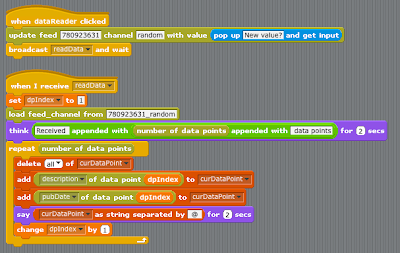
Fragment of Sense script that updates and reads a Xively feed Recently I have been working on getting the Sense platform to work with xively - a cloud service for sharing data from Internet of Things (IoT) devices.  This has been in the context of a project funded by the UK's Technology Strategy Board, called DISTANCE: Demonstrating the Internet of School Things – A National Collaborative Experience . The project will use a number of different IoT devices, from scientific data loggers, air quality monitors, weather stations and the OU's Sense board to demonstrate how learning can be enhanced by IoT technologies.  Working with schools across the UK, we installing these devices in class rooms, playgrounds (really, wherever the students / teachers want) and making the data streams they generate available a xively feeds.  This allows the schools to use each others' data in ways that allows students to carry out experiments using real data gathered from sites a...

SenseHub: an online community of Digital Makers

SenseHub - Nesta Digital Makers Call from Arosha Bandara on Vimeo . Some time ago, I helped put together a proposal to the Nesta Digital Makers Fund to create a online community portal that would help young digital makers to learn about, collaborate on and share Internet of Things prototypes, that were built using the Open University's Sense Kit . The video above was part of this proposal and last week we got the exciting news that we have been shortlisted to come and pitch our idea in person to the selection panel.  This call for proposals attracted a whole collection of really interesting ideas and it is really great to have our idea selected for the next round of the process.  Pitch day is in a week's time and hopefully I'll have further good news to write about the SenseHub very soon!

Priming Code Club

Code Club Assembly Presentation from akbandara As part of my work with STEMnet, I recently signed up as a CodeClub volunteer at St. Bernadette's Catholic Primary School in Milton Keynes.  Working with Kate Clarke, the ICT leader at the school, I am going to be leading an after-school club that will introduce kids in Year 5 and Year 6 to the exciting world of programming.  CodeClub is a nationwide, volunteer driven, grass-roots movement to get kids learning about the fun that can be had programming computers, rather than simply using them. In order to give the kids some idea about what they might be letting themselves in for, last week I delivered the short presentation (embedded above) at the school.  I started out by getting the kids to identify different computers, and think about what a computer really does, i.e. follows a set of instructions to complete a task.  We then played with a neat little iPad game called 'Kodable' which allows the player t...

Quick2Wire Interface Board

Image
I dusted the cobwebs off my soldering iron today to build this interface board for my Raspberry Pi.  Designed by Quick2Wire ( http://quick2wire.com ), the board simplifies the access to the GPIO and I2C pins of the Raspberry Pi, making it possible to integrate sensors and actuators into programs running on the device.  After constructing the board, I wrote a simple bash script to write to a pin (connected to a test LED on the board) and also read the state of another pin (connected to a push button switch). My next step is to get the Quick2Wire Python API working so that I can try and writing my own programs that interact with the pins.  In the longer term, I am hoping to be able build a version that can be controlled using Sense ( http://sense.open.ac.uk ).