Posts

"First, do no harm" - transdisciplinarity and responsible software engineering

Image
Transdisciplinary Research for Responsible Software Engineering When we think about professions guided by the principle  “First, do no harm,”  medicine usually comes to mind. Although the phrase doesn’t actually appear in the Hippocratic Oath, the spirit of it permeates healthcare: a duty to safeguard the wellbeing of the public by maximising the potential benefit and minimising the risk of harm. Software engineering now finds itself facing a similar responsibility. Digital systems shape our safety, our autonomy, our relationships, and our access to opportunity. As software increasingly blends with the physical and social world, the boundaries between the technical and the human become blurred. This means software engineers must grapple with a fundamental ethical question:  How do we build technology that maximises benefits while minimising the risk of harm? From Clear Boundaries to Complex Realities Traditional software engineering assumed neat, well‑defined system bound...

Love work, even if it doesn't love me back ...

Image
"Work won't love you back" As the end of 2024 loomed, inspiration for my last blog post of the year (now first blog post of the new year!) was hard to come by, and I asked some colleagues for ideas. One suggestion was:  "Looking back 10 years, how does your current career align with your past vision and goals—have they changed? " As I reflected on this, I recollected one key goal from much earlier in my career - based on the much quoted aphorism that "If you do what you love, you won't work a day in your life" . This is seen as an achievable goal in academia, where we have a lot of flexibility and agency to pursue our research interests and teach subjects related to these interests. However, over the years I have seen (and personally experienced) how this can be a double-edged sword - used wisely a useful tool to motivate us to overcome challenges, but if used unskilfully can be harmful to oneself and others. This latter aspect is the focus of one ...

Towards Safety by Design for Protecting Women Online

Image
  I was pleased to be invited to join a panel discussion on 'Safety by Design' at the Refuge Tech Safety Summit (https://refugetechsafetysummit.vfairs.com). The panel included colleagues with experience in improving online safety at various technology companies, including some of the major online social media platforms. The focus of the discussion was to explore some of the types of harm experienced by women and girls, together with things that are being done to mitigate these harms. My contributions focussed on some of the barriers and challenges to achieving safety by design in online platforms and the work that we are embarking on at the OU's Centre for Protecting Women Online .  The complexity of mitigating online harms to women and girls is compounded by the heterogeneity and dynamicity of these harms, together with the challenges of navigating the diverse viewpoints from which harms are understood. These viewpoints include our understanding of online harms from th...

Software Engineering Outside the Box

Image
"Unboxing responsible requirements engineering" In December 2023, I attended the ESEC/FSE conference in San Francisco, and in addition to hearing about lots of interesting work relating to human aspects of software engineering, and security, I also enjoyed listening to the keynote talks delivered at the event. I already shared some reflections on one of these keynotes in a previous blog post ( GenAI for Software Engineering ) and in this one I cover my notes on another keynote which was delivered by Professor Margaret Burnett, a University Distinguished Professor from Oregon State.  Her talk was titled " Getting outside the Bug Boxes " and highlighted the importance of distinguishing between the goals (or policies) of software engineering from the mechanisms (or tools and methods) used to engineer software. The central thesis was that, too often, software engineers constrain themselves inside a box that is based on the latter and therefore miss important aspects of ...

(Academic) Leadership ... in "13 Days"

Image
Reflections on academic leadership ... In Dec 2017, I had just been appointed Head of the School and asked a wise colleague for guidance on meeting the challenges of the role. Knowing that I am a film buff, she gave me a copy of a movie called "Thirteen Days" (2001) together with a brief note highlighting some key leadership behaviours that she felt were important to learn. At the time, I noted the key points she had written but never actually got around to watching the movie - mainly because it was on a DVD and we no longer had a player in the house!  I completed my tenure in the role, with some successes but also faced several challenging situations.  My colleague's advice was useful when faced with particular challenges, but I also found a need to adapt some aspects of the guidance to fit my personality and style. Six years later, as we approach the end of 2023, I noticed that "Thirteen Days" was available on one of the streaming services we subscribe to and ...

GenAI for Software Engineering: "If you can specify it, I can synthesise it"

Image
Will AI agents become integral members of software engineering teams? I recently attended the ESEC/FSE conference in San Francisco, where one of the keynote talks was titled " Towards AI-driven software development: challenges and lessons from the field " and delivered by Professor Eran Yahav from Technion. This post summarises my notes on the key messages of the talk. Part of the context for the talk was a recognition that generative artificial intelligence (GenAI) technologies are seeing increasing usage across all stages of the software development lifecycle. Of course, the extent to which they are used is not uniform across all stages, with the most significant usage being for code and test generation. However, as demonstrated by some of the papers presented in other sessions of the conference, the step change in capability realised by the public release of LLMs over the past year has led to researchers exploring the use of GenAI in deployment and maintenance scenarios, f...

Having presence, being present ...

Image
As another year draws to a close, I find myself reflecting on the experience of the 12 months just gone and what could be learned for the year ahead. One of the features of the past year was how my interactions with colleagues, friends, and family transitioned from being mostly online to a ‘hybrid’ mode of engagement. My experience of hybrid varied from alternating between online and in-person interactions with people, to attending gatherings where there were a mixture of online and in-person participants.  The different activities I was involved in over the year highlighted the different ways in which having presence and being present play a more significant role in our interactions that the modality of the engagements themselves. Here I am distinguishing different types of hybrid interaction by considering the dimensions of time and space. Sometimes an interaction is hybrid because it depends on people being together at the same time, but distributed in different places (some co-...

Managing Your Mental Health During Your PhD — A Survival Guide

Image
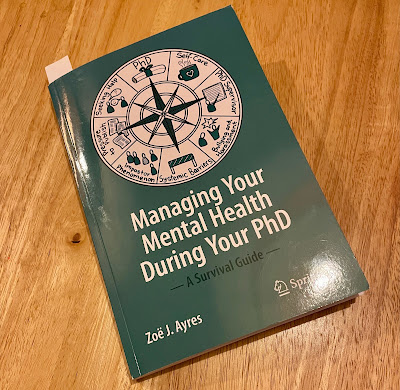
Content warning: mental health, anxiety,  depression. I have just finished reading "Managing Your Mental Health During Your PhD — A Survival Guide" by Dr. Zoë J. Ayres, which is an important resource for PhD students and supervisors.  It is definitely a book that I wish was available when I did my own PhD and I am writing this review to help highlight why it is a useful addition to the resources we use in supporting PhD students. Completing a doctoral research project, writing up and defending a thesis with the goal of being awarded a PhD can be a challenging undertaking and it is not unusual for a students to experience some downs (and ups) in their mental health. This was certainly my experience, where my mental health went through all of the following at different stages of the process:  disorientation as I moved from industry to academia; a sense of accomplishment when I presented my first paper at a workshop; anxiety as I felt unsure of whether my work was good enou...

Not done? Well done!

Image
“When will I be done?” - in a busy working life, with lots of tasks demanding our time, this is a question that arises from time to time.  In the break from work at the end of another year, I am reminded to reflect on the things that I have done and a particular conversation with a group of friends where we discussed what “being done” means to us. The discussion explored the role of different goals in our lives and what we each defined as the point of having freedom from obligations to do what we want. Some of the common themes related to the independence of our children and retirement from work. I also noted a sense that all of us felt that we were really busy right now, and there were plenty of things on the horizon that would also need our attention in the next month or so, but ‘things would get better after that’. This is a recurring theme I have observed both within myself and among colleagues and from other academics who share experiences online. Of course the reality of ou...

My road to “Inbox Zero”

Image
My out of office message in on, my inbox is empty ... Image by Solen Feyissa from Pixabay My out of office message is on, my inbox is empty ... and mesmerised by Microsoft's floating balloon animation, I thought of writing about how I got here. Keeping up with all the information, requests for action and questions that flow into our email inboxes often seems a losing battle, but it doesn’t have to be so. It is increasingly common to see colleagues share their victory over the deluge of messages by reaching “Inbox Zero” and it is something I have improved my ability to do over the past couple of years.  I don’t always get to zero every day or week, but I can often get to below 10 messages to deal with, and even hit zero from time to time. My method is similar to that adopted by others, but I thought of documenting it here as a way for me to refer to it in the future, and also in case it helps others. Unread e-mails result https://t.co/DdB3jZJ3pp pic.twitter.com/q7hoTFHCUi — PHD...

Academic Acrobatics: Self-care for mutual support

Image
At a recent research away day, attendees were prompted to reflect on their personal values and share an image that could represent these.  The image I shared was based on the picture shown above, and was inspired a story from Buddhist teachings called the Sedaka Sutta . In the teaching, the Buddha describes two acrobats who were talking about how best they should work together: Once upon a time, monks, a bamboo acrobat,  setting himself upon his bamboo pole,  addressed his assistant Medakathalika:  "Come you, my dear Medakathalika,  and climbing up the bamboo pole,  stand upon my shoulders."  "Okay, master" the assistant Medakathalika  replied to the bamboo acrobat;  and climbing up the bamboo pole  she stood on the master's shoulders. So then the bamboo acrobat said this to his assistant Medakathalika:  "You look after me, my dear Medakathalika, and I'll look after you.  Thus with us looking after one another, guarding ...

Reflecting for kindness: one pebble at a time

Image
from the Mental Health Foundation ( https://www.mentalhealth.org.uk ) This is "Mental Health Awareness Week" ( https://www.mentalhealth.org.uk/campaigns/mental-health-awareness-week ) and the theme being highlighted by the Mental Health Foundation is kindness. Often kindness focusses on how we treat others, whether by helping when we see someone in need, or spontaneously. We are also reminded of the importance of being kind to ourselves but this is something that can be more challenging. The following are some personal reflections on kindness to oneself, influenced by talks heard, things read, and words and deeds done and seen over the years. Our kindness aims to alleviate someone's pain, or help them overcome a challenge, or even simply to surprise them with something they enjoy. Whatever the context in which kindness manifests, one thing I've noticed is that it has the greatest impact when it is rooted in a good understanding of the other person's situati...

2019: Reflecting and learning

Image
Image by Sasin Tipchai from Pixabay Normally, when writing this end of year reflection I have focussed on all the successes that I have experienced and not mentioned any of the challenges or failures that always punctuate academic life. From the missed deadlines for research papers or grant applications, to the seemingly inevitable rejections that follow those that do get submitted, and the sense of being overwhelmed by the sheer amount of work - these are common experiences to all of us in academia and indeed versions of these experiences are common to everyone. It is not a revelation that challenging experiences and failures in life are important learning opportunities - indeed more important than the successes in some respects.  Reflecting on both types of experience to reinforce positive behaviours and identify areas to adapt ones behaviour when needed, but it is not necessarily a given that this learning happens.  My own practice in this regard has been inconsiste...